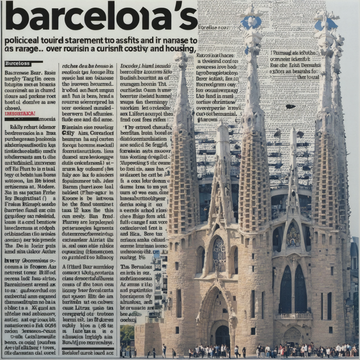
Barcelona’s decision to raise the tourist tax is more than a fiscal tweak; it is a political statement about what kind of city Barcelona wants to be. From April 1, 2026, Catalonia’s new rules double the regional levy in Barcelona, meaning visitors may face total charges of roughly €10 to €15 per night in hotels, while tourist apartments can reach €12.50. Crucially, at least 25% of the revenue collected by the regional government is earmarked for housing policy. In a city where tourism has become both an economic engine and a social irritant, the tax is being presented as a way to make visitors shoulder more of the urban cost they help generate. (catalannews.com)
The background is hard to ignore. Spain received a record 96.8 million foreign visitors in 2025, and Catalonia alone attracted about 20.1 million of them. Barcelona, meanwhile, has become a symbol of overtourism: not simply because of crowded landmarks, but because tourism and housing now intersect in everyday life. The city’s own 2024 perception survey found that 63.7% of residents believe tourist accommodation causes significant or considerable disruption in their neighbourhoods. That frustration has already translated into policy: Barcelona says it will not renew around 10,000 tourist-flat permits after November 2028, pushing those homes back toward the residential market. (apnews.com)
Will the tax “save” the city? Only in a limited sense. It can help fund cleaning, security, transport, and other services strained by heavy visitor flows; Barcelona City Council expects tourism-related taxation to bring in about €100 million in 2025, and it has already used such revenue for resident-focused projects. In that respect, the measure is rational: it internalizes part of tourism’s external cost. But taxes alone do not manufacture affordable homes, and they do not automatically reverse rent inflation or speculative pressure. (ajuntament.barcelona.cat)
So the tax hike is best understood not as a cure, but as a test. If it remains a revenue tool without deeper housing reform, it will be little more than an expensive conscience-payment. If, however, it works in tandem with stricter controls on tourist rentals and sustained investment in housing, Barcelona may yet prove that a city can remain open to the world without surrendering itself to it.