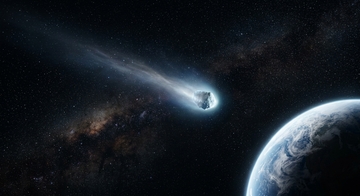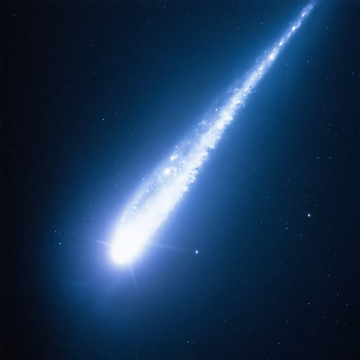
Comet 3I/ATLAS is not an ordinary comet. It came from outside our solar system, so astronomers call it an interstellar object. It is only the third known visitor of this kind, after 1I/ʻOumuamua in 2017 and 2I/Borisov in 2019. The NASA-funded ATLAS telescope in Río Hurtado, Chile, first reported it on July 1, 2025, and older images later showed that it had already been seen on June 14. The name “3I/ATLAS” means it is the third known interstellar object, discovered by the ATLAS survey. (science.nasa.gov)
The good news is that 3I/ATLAS never threatened Earth. NASA says it stayed about 1.8 astronomical units, or 270 million kilometers, from our planet. It reached its closest point to the Sun around October 30, 2025, just inside the orbit of Mars. Its path is not a loop around the Sun, so after this visit it will head back into deep space and not return. Hubble also saw dust streaming from the comet, and NASA says its icy center may be somewhere between about 440 meters and 5.6 kilometers wide. (science.nasa.gov)
NASA and ESA used many “eyes” to follow this rare traveler. Hubble and Webb studied its dust, size, and chemical makeup. When the comet moved too close to the Sun to be seen well from Earth, NASA’s Parker Solar Probe photographed it from October 18 to November 5, 2025, giving scientists a special view near the Sun. NASA’s Europa Clipper also observed the comet on November 6 and collected ultraviolet data to study the comet’s coma, the cloud of gas and dust around it. (science.nasa.gov)
ESA added another exciting part to the story. Using data from the ExoMars Trace Gas Orbiter around Mars, ESA improved the comet’s predicted path by a factor of 10. Later, ESA’s Juice spacecraft saw a bright coma and hints of two tails, and in February 2026 ESA released a first science-camera image of 3I/ATLAS. ESA’s XMM-Newton observatory also saw the comet glowing in X-rays, produced when gas from the comet met the solar wind. For scientists, 3I/ATLAS is like a small message from another star system. For the rest of us, it is a wonderful reminder that the universe still sends surprises our way. (esa.int)