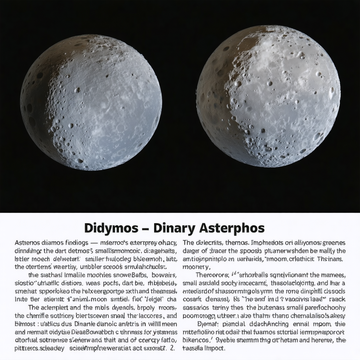
When NASA’s DART spacecraft crashed into the small asteroid moon Dimorphos on September 26, 2022, the mission was designed to test planetary defense. It worked: DART shortened Dimorphos’s orbit around the larger asteroid Didymos from 11 hours 55 minutes to 11 hours 23 minutes. But scientists are still learning from the pictures DART took in its final seconds, and one new result is especially surprising: these two asteroids seem to throw rocks at each other. (science.nasa.gov)
In a study published on March 6, 2026, researchers reported faint fan-shaped streaks on Dimorphos’s surface. They think these marks were made by slow impacts from material that left Didymos and drifted across space before landing on Dimorphos. The team called them “cosmic snowballs,” but they are not made of ice. They are probably small rocks, dust, or loose clumps of rubble moving so slowly that they gently hit the surface instead of exploding like normal meteor impacts. This is the first direct visual evidence that a binary asteroid system can naturally exchange surface material. (cmns.umd.edu)
So why does this happen? First, gravity on small asteroids is extremely weak, so even a gentle push can send material into space. Second, Didymos spins very fast. NASA says this rapid rotation likely helped create Dimorphos in the first place through rotational fission: material was shed from Didymos, and some of it gathered into the smaller moon. Later studies of DART data also suggest that both bodies are loose “rubble piles,” not solid single rocks, so their surfaces can move, break, and shed material more easily. In other words, these asteroids are less like hard baseballs and more like floating piles of broken stone. (science.nasa.gov)
This matters for Earth, too. About 15% of near-Earth asteroids are binary systems, and understanding how rocks move around them helps scientists predict how such bodies change over time—and how they might react if we ever need to deflect one. DART has already shown that even a small spacecraft can change an asteroid system’s motion, and ESA’s Hera mission is now on its way for a close-up inspection in late 2026. Hera may even see whether these strange “snowball” marks survived the DART crash. (cmns.umd.edu)