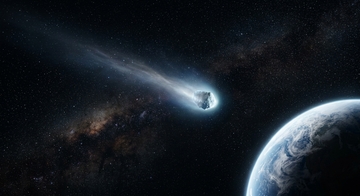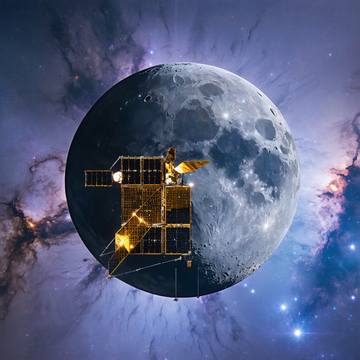
For a while, asteroid 2024 YR4 looked like a space mystery. It was discovered in Chile on December 27, 2024, and early calculations suggested a small chance of an Earth impact on December 22, 2032. That danger was later ruled out, but scientists still saw a possible Moon impact on the same date. At one stage, NASA estimated that lunar impact chance at 4.3%. The asteroid is now thought to be about 53 to 67 meters wide, roughly the size of a 15-story building. (science.nasa.gov)
So why did the answer change to “no”? The important point is that the asteroid did not suddenly change direction. Our knowledge changed. NASA says the new result reflects improved precision in the orbit, not a shift in the orbit itself. Early on, astronomers had only limited data, so the asteroid’s future position in 2032 was still uncertain. ESA also explains that 2024 YR4 approached from the day side of Earth, hidden in the Sun’s glare, and was found only after its closest pass. (science.nasa.gov)
The real breakthrough came from the James Webb Space Telescope. Webb observed the asteroid on February 18 and February 26, 2026, when it had become too faint for most other observatories. Using those difficult measurements, NASA’s Center for Near-Earth Object Studies refined the orbit enough to eliminate any chance of a lunar impact. NASA now expects 2024 YR4 to pass about 13,200 miles, or 21,200 kilometers, from the Moon’s surface on December 22, 2032. (science.nasa.gov)
In simple terms, scientists shrank the “uncertainty zone” around the asteroid’s future path until it no longer included the Moon. That is why the possible 2032 lunar collision became “none.” This is a great example of how planetary defense works: first comes a warning, then more observations, then a clearer answer. In the case of 2024 YR4, better data—not a last-minute miracle—showed that the Moon is safe. (science.nasa.gov)