In April 2026, Artemis II gave the world a fresh look at the far side of the Moon. NASA astronauts Reid Wiseman, Victor Glover, and Christina Koch, together with Canadian astronaut Jeremy Hansen, launched on April 1 and returned to Earth on April 10. The mission lasted 9 days, 1 hour, and 32 minutes, making Artemis II NASA’s first crewed lunar flyby in 50 years. (nasa.gov)
The most exciting views came during a seven-hour flyby on April 6, 2026. NASA said the crew captured the first Artemis II flyby images of the Moon’s far side, along with an in-space solar eclipse. Before the mission, NASA expected the far side’s partial sunlight to create long shadows, and those shadows would help show the shapes of ridges, slopes, and crater rims more clearly. In one close-up image, long shadows stretch across Vavilov Crater near the older Hertzsprung Basin. In another, the line between lunar day and night makes crater rims stand out like islands in darkness. (nasa.gov)
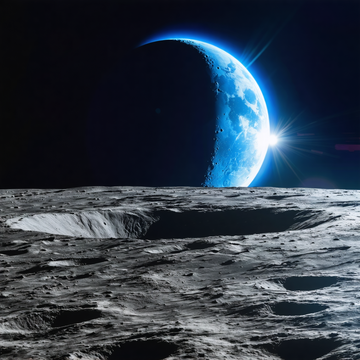
One of the most beautiful pictures shows “Earthset.” At 6:41 p.m. EDT on April 6, a blue crescent Earth seemed to sink behind the Moon’s horizon. NASA says white clouds could be seen over Australia and Oceania, while the dark part of Earth was in nighttime. Another image showed the Moon backlit during a solar eclipse, with Saturn and Mars appearing as bright points nearby. These pictures are not only beautiful. They also remind us how small and bright Earth looks when seen from deep space. (nasa.gov)
These new views matter because Artemis II was more than a sightseeing trip. NASA says the mission helped test Orion and train astronauts to make useful science observations for future Moon missions and, later, Mars missions. For learners of English, Artemis II offers a simple message: when people travel farther, they do not just go to new places. They also learn to see familiar places in a new way. (nasa.gov)