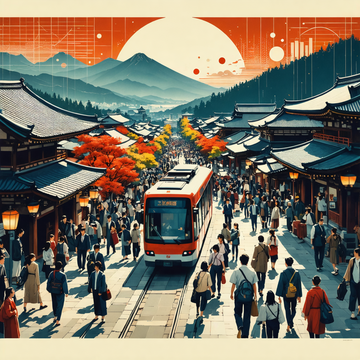
Kyoto’s struggle with overtourism has become a test case for historic cities everywhere. In 2024, the city recorded about 16.3 million overnight guests, up from about 14.7 million in 2023. At the same time, a 2025 city survey found that 71.4% of residents felt bothered by crowding around tourist areas, 67.0% by packed buses and subways, and 55.0% by bad tourist manners. In other words, Kyoto is not dealing with an abstract policy problem. It is dealing with daily friction in ordinary life. (city.kyoto.lg.jp)
Its first major response is financial. After formal approval on October 3, 2025, Kyoto’s revised accommodation tax took effect for stays from March 1, 2026. The new rates are more sharply tiered: ¥200 for stays under ¥6,000; ¥400 for ¥6,000 to ¥19,999; ¥1,000 for ¥20,000 to ¥49,999; ¥4,000 for ¥50,000 to ¥99,999; and ¥10,000 for stays of ¥100,000 or more, per person per night. City documents say the revision is meant to ask visitors to bear a fairer share of the costs of sustainable tourism, and the city expects about ¥12.6 billion in annual revenue. That money is intended not just for promotion, but also for congestion measures, cultural preservation, landscape protection, and urban infrastructure that serves residents as well as travelers. (city.kyoto.lg.jp)
The second response is practical rather than fiscal: move people better. Kyoto’s Tourist Express Bus, launched in June 2024, was designed to separate tourist demand from residents’ everyday bus use on heavily crowded corridors. Running on Saturdays and holidays, the service links Kyoto Station with major eastern sightseeing areas such as Kiyomizu-dera, Gion, Okazaki Park/Heian Shrine, and Ginkaku-ji, with an adult fare of ¥500. By October 2024, cumulative ridership had already passed 100,000, and Kyoto says the service made a measurable contribution to easing crowding on parallel routes. The city continued refining the system in 2025 and included bus crowd-control measures again in its spring 2026 tourism strategy. (city.kyoto.lg.jp)
Taken together, these policies suggest that Kyoto is trying something more sophisticated than simply “limiting tourists.” It is building a coexistence model: collect more from visitors who can afford to pay, reinvest that money in transport and preservation, and make tourism less damaging to local life. For a city as famous and fragile as Kyoto, that may be the most realistic path forward. (city.kyoto.lg.jp)