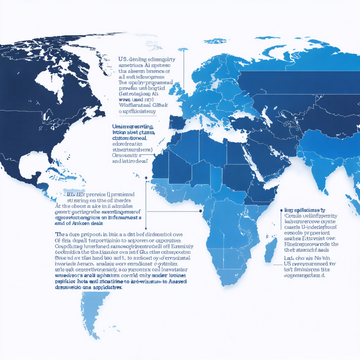
At the India AI Impact Summit in New Delhi in February 2026, Washington offered a strikingly revisionist definition of “AI sovereignty.” Michael Kratsios, the White House science adviser, argued that sovereignty does not require every nation to build an entire AI stack from scratch. Instead, in the U.S. view, countries can remain politically autonomous while adopting “best-in-class” American components, keeping sensitive data inside their own borders, and nurturing domestic firms on top of that imported foundation. In other words, the United States is reframing sovereignty from technological self-sufficiency into strategic alignment with an American-led stack. (whitehouse.gov)
This was not an isolated speech. It rests on a policy architecture launched in July 2025, when the White House created the American AI Exports Program and said it would promote full-stack export packages including hardware, data systems, models, cybersecurity, and sector-specific applications. At the India summit, the administration added new instruments: a National Champions Initiative to plug partner-country firms into customized U.S. export stacks, a Peace Corps “Tech Corps” for last-mile implementation, new financing routed through U.S. agencies and a World Bank-linked fund, and NIST’s AI Agent Standards Initiative to shape interoperable standards for the next generation of autonomous systems. (whitehouse.gov)
The larger significance is geopolitical. Washington is no longer merely competing to invent the strongest models; it is trying to make the world run on American infrastructure, standards, and service networks. That ambition now appears in bilateral “Technology Prosperity Deals” as well. Agreements with South Korea and Japan explicitly promote exports across the full AI stack, while the Korea deal even envisions joint export efforts across Asia and beyond to foster a shared regional ecosystem. The White House’s AI Action Plan is similarly blunt: exporting American AI is a means of extending U.S. technological influence and reducing reliance on rival systems. (whitehouse.gov)
Yet the idea remains contested. India used the summit to present itself as a bridge between advanced economies and the Global South, while Prime Minister Narendra Modi promoted domestic development with global reach. António Guterres, by contrast, warned that AI’s future should not be decided by a small club of powerful states or billionaires and called for a $3 billion global fund to build basic AI capacity in poorer countries. Mozilla advanced a third position altogether: real digital sovereignty, it argued, depends on open-source AI rather than perpetual dependence on a few vertically integrated foreign platforms. Taken together, these rival visions suggest that the next tech order will be organized less by universal consensus than by competing models of dependence, autonomy, and control. (apnews.com)