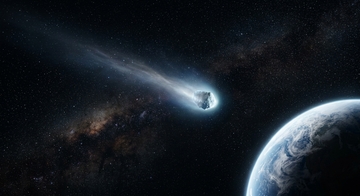
Sometimes the best space story is an accident. Scientists did not plan to watch a comet break. A team at Auburn University had to change to a new target after Hubble’s observing limits became stricter while the telescope moved into one-gyro operations. They chose comet C/2025 K1 (ATLAS). Then, by pure luck, the comet began acting strangely just before Hubble’s scheduled observations, so the telescope caught the breakup almost as it happened. (wire.auburn.edu)
The new study was published online in Icarus on February 6, 2026. It says comet C/2025 K1 passed closest to the Sun on October 8, 2025, at only 0.33 astronomical units. Ground-based telescopes saw a strong brightening between November 2 and 4. Hubble then observed the comet on November 8, 9, and 10, only days later, and saw that the nucleus had already split into at least five pieces. This gave astronomers one of the earliest clear close-up views of a comet falling apart. (sciencedirect.com)
So, what is the “secret” Hubble found? The breakup and the brightening did not happen at the same time. By tracking the fragments backward, the researchers found that the comet likely broke first, and became much brighter one to three days later. This is important because many people expected fresh ice to make the comet brighten right away. Instead, the study suggests that the newly opened inside of the comet needed a little time to warm up before it could release dust well. Gas alone is harder to see, but dust reflects sunlight strongly. (sciencedirect.com)
That delay helps scientists understand how comets die. A breaking comet is also valuable because its inside is usually hidden for billions of years. When it cracks open, astronomers can study older material from the early solar system. Researchers also reported that C/2025 K1 looked chemically unusual, with very low levels of some carbon-bearing molecules. In other words, Hubble did not just watch a comet shatter. It opened a small window into the solar system’s ancient past. (sciencedirect.com)