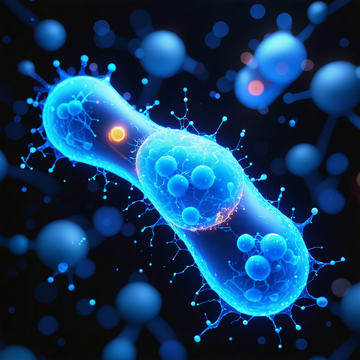
Can a “virtual cell” truly reproduce life? The newest evidence suggests: not fully, but far more convincingly than before. In March 2026, researchers reported in Cell that they had built a four-dimensional whole-cell model of JCVI-syn3A, a genetically minimal bacterium. “4D” here means three-dimensional space plus time. Their model follows the cell through DNA replication, RNA and protein production, metabolism, growth, and division across a roughly 100-minute life cycle. Syn3A was an ideal target because it is unusually simple: it has a single 543-kilobase circular chromosome and 493 genes. (sciencedirect.com)
What makes the study remarkable is not just its visual impact, but its predictive power. The model recovered experimental measurements such as doubling time, mRNA half-lives, protein distributions, ribosome counts, and DNA-replication patterns. According to the University of Illinois team, one full 105-minute cycle could be simulated in about six days of computer time, and repeated runs came within about two minutes of the real cell cycle on average. In other words, this was not merely a beautiful animation, but a testable, data-driven reconstruction of a living system. (sciencedirect.com)
Still, “reproducing life” is not the same as “creating life.” The researchers note that the system is not an atom-by-atom copy of the bacterium, and a recent Nature Biotechnology editorial argues that a genuine virtual cell will require more than one extraordinarily detailed mechanistic model. The next step, it suggests, is to combine the causal clarity of such simulations with AI’s talent for finding patterns in massive biological datasets. That is a useful reminder: even the simplest cells are still astonishingly complex. (las.illinois.edu)
Yet this achievement matters because it transforms an abstract dream into a practical scientific tool. A faithful virtual cell could let researchers test how metabolism shapes growth, how molecular crowding changes gene expression, or how tiny genetic changes alter division, without performing countless slow laboratory experiments. A complete digital human cell remains far away, but this minimal bacterium shows that the path toward “life in silico” is now real, visible, and scientifically productive. (sciencedirect.com)