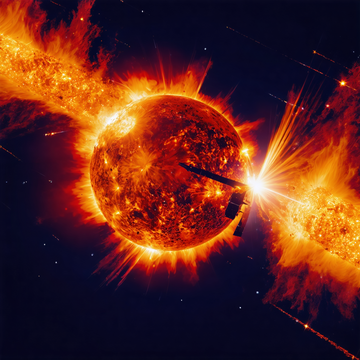
In April 2026, NASA shared an exciting new discovery about huge “explosions” near the Sun. The discovery came from Parker Solar Probe, a spacecraft launched in 2018 to fly closer to the Sun than any earlier mission. At its closest point, it comes within about 3.9 million miles, or 6.2 million kilometers, of the Sun and studies the corona, the Sun’s outer atmosphere. (science.nasa.gov)
These explosions are connected to a process called magnetic reconnection. In simple words, magnetic field lines cross, break, and join again. When this happens, energy is released very quickly, and particles are thrown out at high speed. This process can help create solar storms and other kinds of space weather. Space weather can disturb satellites, radio communication, navigation systems, and even power grids on Earth. (science.nasa.gov)
During a 2022 flyby, Parker Solar Probe passed between the Sun and one reconnection event in the solar wind. This gave scientists a rare chance to measure the particles directly. They found something surprising: protons did not move in the same way as heavier ions. The heavy ions included elements such as helium, oxygen, and iron. The protons spread out like light from a flashlight, but the heavier ions stayed in a much narrower beam, more like a laser. (science.nasa.gov)
This was an important surprise because older theories expected protons and heavy ions to speed up in the same way. The study, published in late March and early April 2026, shows that the Sun’s particle acceleration is more complex than scientists thought. If researchers understand these solar explosions better, they may improve space-weather forecasts and better protect astronauts and technology near Earth. Even though the Sun is our nearest star, it still has many secrets waiting to be discovered. (science.nasa.gov)