When astronomers first spotted 3I/ATLAS on July 1, 2025, they knew immediately that it was no ordinary comet. Its path is hyperbolic, meaning the Sun cannot hold it in a closed orbit, so it is only passing through our neighborhood before disappearing back into interstellar space. That makes it just the third confirmed object from outside the solar system, after ‘Oumuamua and 2I/Borisov. Early orbit studies also suggested that 3I/ATLAS is probably ancient—roughly 3 to 11 billion years old—so it may be older than our own solar system. In other words, this is not just a visitor from far away; it may be a relic from a much earlier chapter of the Milky Way. (science.nasa.gov)
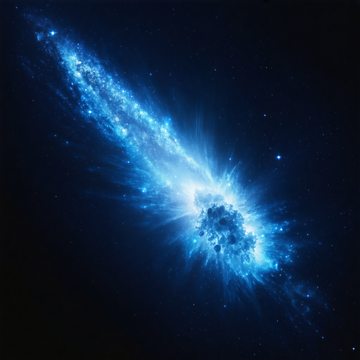
Yet the most fascinating surprise is that 3I/ATLAS is both strange and familiar. NASA observations show a classic cometary appearance: an icy nucleus, a surrounding coma of gas and dust, and outgassing that increased as sunlight warmed it. Hubble estimated the nucleus to be somewhere between about 440 meters and 5.6 kilometers across. SPHEREx then found a huge carbon-dioxide coma extending at least 348,000 kilometers, along with water ice, and even noted that the object “may not be so different” from comets formed around our Sun. So although 3I/ATLAS came from another star system, it still behaves in recognizably comet-like ways. (science.nasa.gov)
What really challenges our idea of “normal” is its chemistry. A Nature Astronomy study based on ALMA observations near perihelion found that the comet’s water is dramatically enriched in deuterium compared with solar-system comets, implying formation in an exceptionally cold and chemically distinct environment. That does not overturn everything we thought we knew. Instead, it gives us a subtler lesson: the basic architecture of comets may be common across the galaxy, while the details of their chemistry can preserve the signature of very different birthplaces. 3I/ATLAS does not destroy the solar system’s “normal.” It shows that our normal may simply be one local version of a much bigger cosmic pattern. (nature.com)