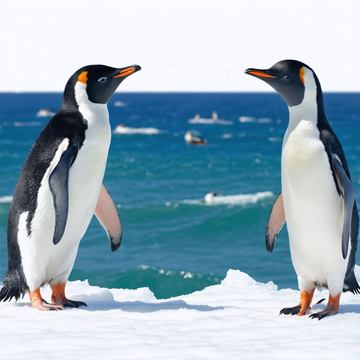
People know the gentoo penguin as one cute penguin with a bright orange bill. But in April 2026, scientists said something surprising: the “gentoo penguin” is not one species. It is four species. Their study was published on April 23, 2026, in Communications Biology, and UC Berkeley shared the news on May 8, 2026. (nature.com)
The team studied whole-genome data from 64 penguins in 10 breeding colonies across almost the full gentoo range. They found four clear groups. One group is so different that it is a totally new species for science: the southeastern gentoo, Pygoscelis kerguelensis. The other three are now also treated as full species: the northern gentoo, the eastern gentoo, and the southern gentoo. (news.berkeley.edu)
These penguins live far from each other on islands in the Southern Ocean. The northern gentoo lives around the Falkland/Malvinas and Martillo Islands. The eastern gentoo lives on the Crozet, Marion, and Macquarie Islands. The new southeastern gentoo lives on Kerguelen Island and probably nearby Heard Island. The southern gentoo lives on the Antarctic Peninsula, coastal Antarctica, and South Georgia Island. Scientists think these groups became separate over about 300,000 to 500,000 years, helped by island isolation and the Antarctic Polar Front, a major ocean boundary. (news.berkeley.edu)
Why did this happen? Gentoo penguins usually stay close to their home colony and return to the same nesting place year after year. They also eat many kinds of food, such as fish, krill, squid, and cuttlefish, so they do not need to travel far. Over a very long time, life on different islands helped each group change in its own way. (news.berkeley.edu)
This discovery is exciting, but it also brings worry. The study says future habitat loss could be severe for three of the four gentoo lineages. Only the southern gentoo may keep doing well or even spread farther. So this is not only a story about a new penguin. It is also a reminder: when scientists look more carefully, nature can be more diverse — and more fragile — than we thought. (nature.com)