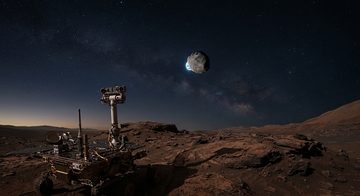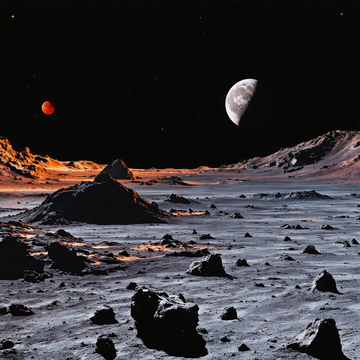
Astronomers have reached a remarkable milestone with the James Webb Space Telescope. In a study published on May 4, 2026, they used Webb to directly characterize the surface of the rocky exoplanet LHS 3844 b by measuring heat coming from its dayside. The planet is about 48.5 light-years away, about 1.3 times wider than Earth, and races around its small red star in only about half a day. Because it is tidally locked, one side always faces the star, and that dayside is extremely hot, around 1,000 kelvin. (nature.com)
This does not mean Webb took a sharp photograph of the planet’s ground. Instead, the telescope’s MIRI instrument studied the planet’s infrared spectrum, splitting its heat into different wavelengths. That spectrum works like a fingerprint. By comparing the data with known rocks from Earth, the Moon, and Mars, the team found that the surface is best explained by dark, low-silica rock such as basalt or olivine-rich mantle material. An Earth-like crust rich in granite does not fit the data. (mpia.de)
The result makes LHS 3844 b sound less like a second Earth and more like a harsh, airless world. Earlier work had already suggested that the planet lacks a thick atmosphere, and the new Webb data also found no strong sign of volcanic gases such as sulfur dioxide. The researchers say there are two main possibilities: either the planet has relatively fresh dark volcanic rock, or it has an older surface covered by space-weathered material, like the dusty regolith seen on the Moon and Mercury. (nature.com)
At the moment, the second idea seems more likely, because Webb did not detect the gases that active volcanism would probably release. If that picture is correct, LHS 3844 b is a dark, hot, barren rock shaped by radiation and meteorite impacts over a long time. For scientists, this is exciting because it opens a new age of “exoplanet geology”: studying the surfaces of worlds far beyond our solar system, not just their atmospheres. (mpia.de)