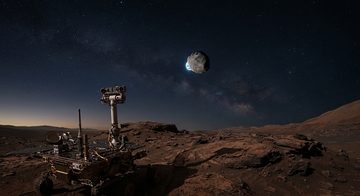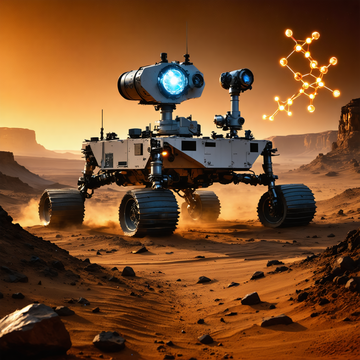
In April 2026, NASA announced that Curiosity had found the most diverse collection of organic molecules ever detected on Mars. The rover drilled the rock sample, called “Mary Anning 3,” in 2020 in the clay-rich Glen Torridon area of Gale Crater. Scientists identified 21 carbon-containing molecules in the sample, and seven of them had never been seen on Mars before. Among them were benzothiophene and a nitrogen heterocycle, a ring-shaped molecule that researchers describe as a possible chemical precursor to RNA and DNA. The result came from Curiosity’s SAM mini-lab, which used a special wet-chemistry method with TMAH to release molecules that are hard to detect. (nasa.gov)
This does not mean NASA has found life on Mars. Organic molecules are carbon-containing compounds, and they can be made by biology, geology, or even delivered by meteorites. NASA says scientists still cannot tell which process produced the new molecules. Even so, the discovery is important because the rock formed in an ancient environment with lakes, streams, and clay minerals, and the molecules appear to have survived roughly 3.5 billion years of radiation exposure and other changes in the rock. In other words, Mars may still be keeping very old chemical records from a time when it was wetter and more habitable than it is today. (nasa.gov)
The new result also connects to another major discovery. In March 2025, Curiosity reported decane, undecane, and dodecane, the largest organic molecules found on Mars so far. Scientists think these may be fragments of larger fatty acids preserved in an ancient mudstone called Cumberland. Then, on February 6, 2026, NASA reported that a follow-up study found the non-biological sources tested could not fully explain the original abundance of those compounds after researchers modeled about 80 million years of radiation damage. That still is not proof of life. But it makes Mars even more interesting: the planet may still hold chemical clues strong enough for future missions—and perhaps one day Earth laboratories—to test the biggest question of all. (science.nasa.gov)