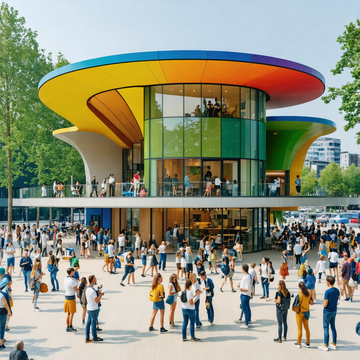
In 2026, Frankfurt RheinMain is not treating architecture as something fixed and silent. As World Design Capital 2026, the region is planning more than 450 participatory projects and around 2,000 events under the theme “Design for Democracy.” One of its clearest symbols is the WDC Pavilion, a structure described by the organizers as “sustainably built, modular and mobile.” Instead of staying in one famous square, it is scheduled to travel across the region from April 13 to September 27, 2026, turning public space itself into a moving place for learning, conversation, and culture. (wdo.org)
That idea matters because the pavilion is designed not just as a building, but as a system. Developed with Constructlab, a transnational network focused on participatory architecture and social design, it can be adapted to different sites and communities. The current tour includes six stops: Bad Homburg, Kelkheim, Offenbach, Wiesbaden, Rheingau, and Darmstadt. At each location, the program changes. Weekdays focus more on workshops and educational activities with schools and local groups, while weekends open up to performances, talks, music, and hands-on events. In other words, the pavilion is a public space that moves, listens, and changes shape with the people around it. (wdc2026.org)
This is also why the project feels like a glimpse of circular architecture. The European Commission describes circular building design as an approach based on durability, adaptability, waste reduction, and high-quality waste management. That is important in Europe, where construction and demolition waste makes up more than one third of all waste generated in the EU. A modular pavilion that can be assembled, used, moved, and re-used in new contexts offers a practical alternative to the old pattern of building once and throwing away later. Frankfurt’s WDC Pavilion suggests a future in which architecture is lighter, more flexible, and more social — less like a monument, and more like a shared tool. (single-market-economy.ec.europa.eu)