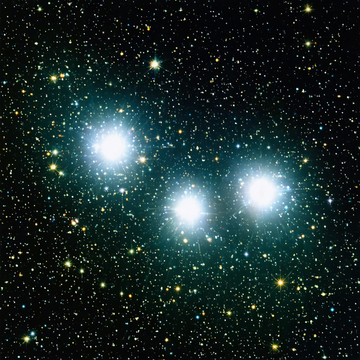
In February 2026, astronomers using Hubble, Euclid, and the Subaru Telescope announced strong evidence for Candidate Dark Galaxy-2, or CDG-2, an almost invisible object in the Perseus Cluster about 300 million light-years away. Instead of appearing as a normal galaxy full of obvious stars, CDG-2 first revealed itself through a suspiciously tight grouping of four globular clusters. Only after follow-up analysis did researchers detect the faint, diffuse glow of the galaxy itself, making CDG-2 the first galaxy identified purely through its globular-cluster population. (esa.int)
What makes CDG-2 so startling is not just its dimness, but its composition. ESA’s summary describes it as roughly 99% dark matter, while the research paper argues that, depending on the assumptions used, the dark-matter fraction could be even higher. Its total luminosity is only around a few million Suns, and an unusually large share of that visible light comes from the globular clusters themselves. In other words, CDG-2 looks less like a normal galaxy with a dark halo and more like a dark halo that barely managed to form a galaxy at all. (esa.int)
This is where CDG-2 begins to challenge the usual “common sense” about galaxies. We often imagine a galaxy as something defined by starlight: first you see the stars, then you infer the dark matter. CDG-2 flips that logic. Here, dark matter seems to be the main structure, while the stars are only a trace left behind. The team suggests that much of its normal gas may have been stripped away by gravitational interactions inside the Perseus Cluster, choking off star formation before the galaxy could become bright. (esa.int)
If that interpretation is correct, CDG-2 implies that today’s galaxy catalogs may be missing a hidden population of ultra-faint systems. It also suggests that globular clusters are not just beautiful relics, but practical signposts pointing to galaxies that ordinary imaging might miss. Euclid’s role in confirming the diffuse light around CDG-2 is especially important here, because it shows that new surveys may uncover many more such ghostly systems and give astronomers a sharper way to test how dark matter shapes galaxy formation. (esa.int)