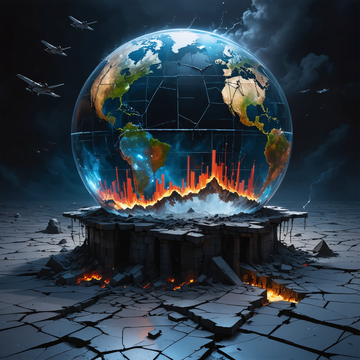
When people hear the word “war,” they usually think first about human suffering. But war also changes the economy in ways that reach far beyond the battlefield. In its World Economic Outlook released on April 14, 2026, the IMF says the global economy is now “in the shadow of war.” The new report focuses on the conflict in the Middle East and warns that the world’s recent progress on lower inflation and steady growth has been weakened. (imf.org)
The numbers show this change clearly. In January 2026, the IMF expected global growth of 3.3% for 2026. In the new reference forecast, that figure has been cut to 3.1%, while 2027 growth is put at 3.2%. Global inflation, instead of continuing to fall smoothly, is now expected to rise to 4.4% in 2026 before easing to 3.7% in 2027. The IMF also says that, without the war, it would probably have raised its 2026 growth forecast to 3.4%. In other words, the conflict did not just slow the world economy a little—it changed its direction. (imf.org)
Why does war have such a big economic effect? The IMF points to three main channels. First, higher energy and food prices raise costs for transport, factories, and families. Second, if workers ask for higher wages and companies raise prices again, inflation can stay alive longer than expected. Third, fear itself matters: nervous investors can pull back, financial conditions can tighten, and businesses may delay spending. The IMF says the closing of the Strait of Hormuz and damage to key energy facilities increase the risk of a wider energy shock. (imf.org)
The pain will not be shared equally. According to the IMF, the conflict region and commodity-importing emerging economies are likely to suffer most, while advanced economies may feel smaller effects. If the conflict lasts longer, the outlook becomes much darker: in the IMF’s severe scenario, global growth drops to 2% in both 2026 and 2027, and inflation rises above 6% by 2027. That is why the IMF urges careful policy: central banks must protect price stability, governments should give temporary targeted help instead of broad subsidies, and countries should strengthen cooperation. In a world shaped by war, calm and smart policy may be as important as courage. (imf.org)