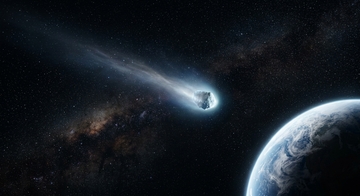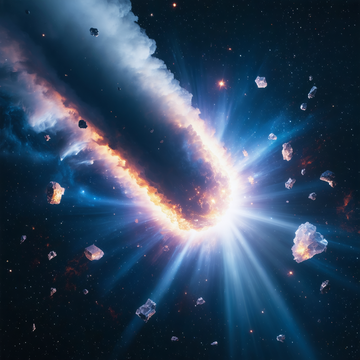
Sometimes space science is planned very carefully, and sometimes it gets a lucky surprise. On March 18, 2026, NASA reported that the Hubble Space Telescope accidentally caught comet C/2025 K1 (ATLAS) in the middle of breaking apart. The researchers had originally wanted to study a different comet, but after a technical change they had to choose a new target. When Hubble looked at K1 on November 8, 9, and 10, 2025, it saw that the comet had already split into at least four bright pieces, and one smaller piece broke up even more while Hubble was watching. NASA says this is the first time Hubble has seen a comet so early in the breakup process. (science.nasa.gov)
K1 had passed its closest point to the Sun, called perihelion, on October 8, 2025. It came inside Mercury’s orbit, only about one-third of the Earth-Sun distance. That is a dangerous trip for a comet. Near the Sun, heat and stress become much stronger, and long-period comets like K1 sometimes begin to fall apart. Before the breakup, K1 was probably around 5 miles, or about 8 kilometers, wide, so it may have been a little larger than an average comet. (science.nasa.gov)
What makes this event especially interesting is the timing. Ground-based surveys saw the comet suddenly brighten between November 2 and 4, 2025, but the new study suggests the main breakup happened about one to three days before that brightening. In other words, a comet may crack open first and only become much brighter later. Scientists think fresh ice inside the comet may need time to warm up before it can release dust efficiently. The study also says that spinning forces, caused by gas escaping from the comet, may have helped tear the nucleus apart. (sciencedirect.com)
This is why comets are so exciting. They are ancient leftovers from the birth of the solar system, but their surfaces have been changed by sunlight and radiation for billions of years. When one breaks open, scientists get a rare look at older material hidden inside. Researchers also say K1 seems unusual because it is strongly poor in carbon-bearing chemicals compared with many other comets. A comet’s death, it turns out, can also be a window into the solar system’s deep past. (science.nasa.gov)