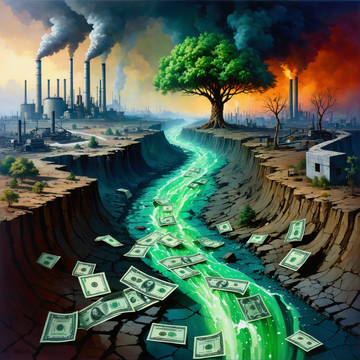
On January 22, 2026, UNEP released State of Finance for Nature 2026, and its central message is almost absurd in its severity: for every US$1 invested in protecting or restoring nature, about US$30 still goes to activities that destroy it. Using 2023 data, the report estimates US$7.3 trillion in nature-negative financial flows, against just US$220 billion for nature-based solutions. The irony is profound. UNEP notes that nearly half of the global economy significantly depends on nature, yet the financial system continues to treat ecosystems as expendable rather than foundational. (unep.org)
This is not merely an environmental contradiction; it is a deeply perverse economic logic. According to UNEP, US$4.9 trillion of the harmful total came from private finance, especially in utilities, industrials, energy, and basic materials. Another US$2.4 trillion came from environmentally harmful public subsidies tied to fossil fuels, agriculture, water, transport, and construction. By contrast, nearly 90 percent of nature-based-solution finance came from public sources, while private investment amounted to only US$23.4 billion. In other words, the market still scales degradation with remarkable efficiency, but treats restoration as a niche activity. (unep.org)
Yet the report is not purely apocalyptic. UNEP argues that annual investment in nature-based solutions must rise 2.5 times, to US$571 billion by 2030, to align with biodiversity, climate, and land-restoration goals; strikingly, that would equal only about 0.5 percent of global GDP. Its proposed “Nature Transition X-Curve” offers a simple but powerful idea: the world must do two things at once—phase out harmful subsidies and destructive investment, while rapidly scaling high-integrity, nature-positive alternatives. UNEP points to practical possibilities already visible in the real economy, from cooling cities through urban greening to embedding nature in transport and energy infrastructure. The report’s deeper lesson is that finance is never neutral: it either accelerates ecological collapse or underwrites recovery. (unep.org)