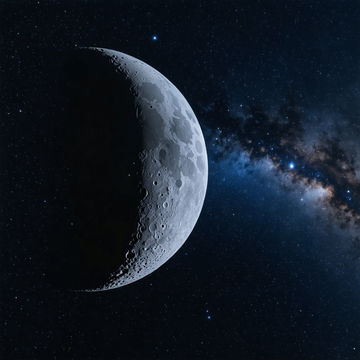
In April 2026, NASA’s Artemis II mission gave the world a new way to see home. On April 6, as the Orion spacecraft flew around the far side of the Moon, the crew took a photo called “Earthset.” In this image, Earth looks as if it is sinking behind the Moon’s horizon. The picture shows a partly lit crescent Earth, blue oceans, white clouds, and the gray, crater-covered surface of the Moon. NASA says the image was taken at 6:41 p.m. Eastern Daylight Time. (nasa.gov)
Artemis II was NASA’s first crewed mission in the Artemis program. Four astronauts were on board: Reid Wiseman, Victor Glover, Christina Koch, and Canadian astronaut Jeremy Hansen. They launched on April 1, 2026, for an approximately 10-day journey around the Moon and back to Earth. One important goal of the mission was to test Orion’s life-support systems with people inside the spacecraft for the first time. (plus.nasa.gov)
The Earthset photo is beautiful, but it is also useful for science. As the crew passed over the Moon’s far side, they photographed and described impact craters, old lava flows, cracks, ridges, and changes in color and brightness on the lunar surface. NASA says these details can help scientists learn more about the Moon’s composition and history. On the same flyby, the crew also reached a major record, traveling farther than any humans in recorded history while flying about 4,000 miles above the Moon’s surface. (nasa.gov)
This photo also reminds many people of the famous “Earthrise” image taken by Apollo 8 astronaut Bill Anders in 1968. NASA directly compares the two pictures. More than 50 years later, Artemis II showed that the Moon can still surprise us with a fresh and emotional view of Earth. The mission ended on April 10, 2026, with splashdown in the Pacific Ocean off the California coast at 8:07 p.m. EDT. Looking at Earthset, it is easy to feel one simple idea: our planet is small, bright, and very special. (nasa.gov)