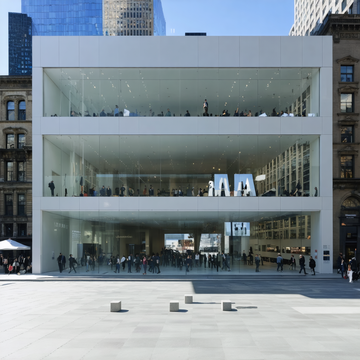
On March 21, 2026, New York’s New Museum is scheduled to reopen with a seven-story, 60,000-square-foot expansion by OMA, led by Shohei Shigematsu and Rem Koolhaas. The project, developed alongside the museum’s 2007 SANAA building on the Bowery, doubles the institution’s gallery space and marks OMA’s first public building in New York City. It will reopen with New Humans: Memories of the Future, an ambitious exhibition bringing together more than 200 artists, writers, scientists, architects, and filmmakers. (archdaily.com)
What makes this addition especially interesting is that OMA did not try to erase or outshine SANAA’s famous stacked-box landmark. Rem Koolhaas has described the new structure not simply as an extension, but as a “counterpart.” In other words, the architecture argues that museums no longer need to behave like solitary monuments. Instead, they can be built as conversations between different forms, eras, and institutional needs. Inside, the expansion aims to solve one of the older building’s biggest weaknesses—awkward circulation—by adding an atrium stair and extra elevators, while also creating a new entrance plaza, larger lobby, enlarged bookstore, restaurant, forum, artist studio, and a permanent home for NEW INC, the museum’s cultural incubator. (wallpaper.com)
That combination may be the project’s real architectural significance. The new New Museum suggests a shift away from the museum as a sealed container for masterpieces and toward the museum as civic infrastructure: transparent, flexible, and visibly active from the street. Shigematsu has emphasized openness, gathering, exchange, and creation, and Wallpaper noted that the design tries to communicate a wider range of activity to the city beyond traditional gallery-going. This implies a broader future for museum architecture—one in which exhibition space still matters, but public space, circulation, collaboration, and urban presence matter just as much. If that idea spreads, the New Museum’s restart may influence not only how museums look, but how they behave. (archdaily.com)