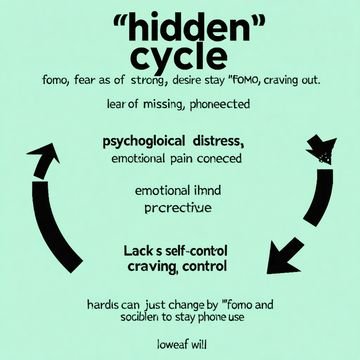
Why do we keep looking at our phones, even when we say, “Just one more minute”? One big reason is FOMO, or “fear of missing out.” Recent research says FOMO is not only fear. It also includes a strong desire to stay connected all the time. In a 2025 study, this “constant connection” part was more strongly linked to problematic smartphone use than simple worry about missing something. (pubmed.ncbi.nlm.nih.gov)
New studies also show that FOMO can lead to phone overuse step by step. In a 2025 study of 1,072 adolescents, FOMO predicted later problematic phone use mainly through psychological distress. In other words, when young people felt more stress or emotional pain, FOMO was more likely to turn into heavy phone use. Another 2025 four-wave study of 509 adolescents found a similar pattern: FOMO could lead to desire thinking and craving, and then to harder-to-control phone use. Daily data from young adults also showed that momentary FOMO was linked to more craving, more time on social media, and more self-control failure. (sciencedirect.com)
Self-control is the other half of the story. A 2024 longitudinal study of 2,131 adolescents found that higher self-control predicted lower problematic smartphone use over time. Part of this effect worked through physical activity: students with better self-control were also more active, and that helped reduce phone overuse. A two-wave study of 1,143 college students also found that lower self-control was linked to later smartphone addiction, partly through more social anxiety and procrastination. (sciencedirect.com)
So, smartphone overuse is not only about “weak will.” Latest research suggests a cycle: FOMO makes us want to check now, stress makes that urge stronger, and low self-control makes it harder to stop. The good news is that habits can change. In a 2025 randomized trial, students who reduced screen time to two hours a day for three weeks showed better well-being, less stress, better sleep, and fewer depressive symptoms, although their screen time went up again later. In another 2025 randomized trial, blocking mobile internet for two weeks improved well-being, mental health, and sustained attention. (bmcmedicine.biomedcentral.com)
So if you check your phone too much, you are not strange. Your mind may simply be trying to stay safe, connected, and informed. Understanding FOMO and self-control is the first step to using your phone more wisely. (pubmed.ncbi.nlm.nih.gov)