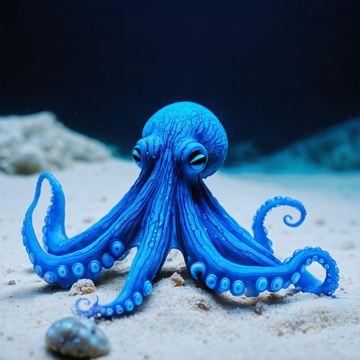
A tiny blue octopus has become one of the newest stars of the Galápagos. In May 2026, scientists officially announced a new species called Microeledone galapagensis. It was first seen much earlier, in July 2015, during a deep-sea trip near Darwin Island in the northern Galápagos. A robot submarine explored the sea floor about 1,773 meters, or 5,800 feet, below the surface. There, the team spotted a very small octopus. It was about the size of a golf ball, and the scientists watching the live video quickly noticed two things: it was tiny, and it looked blue. (mapress.com)
The team collected one specimen and later studied it carefully. They also recorded other similar octopuses nearby, which suggests this was not just one lonely animal. The new species lives on the deep sea floor, where the animals were seen resting on sand near underwater mountains. The octopus has short arms, smooth skin, and only one row of suckers on each arm. It also has no ink sac, which is unusual for many people who think all octopuses can spray ink. (mapress.com)
Studying this animal was not easy. The researchers had only one collected specimen, so they did not want to cut it open. Instead, they used CT scans to look inside its body. These scans helped them see important parts such as the mouth and other organs, and that gave them enough information to confirm that it was a new species. This is a great example of how new technology can help science while protecting rare animals. (darwinfoundation.org)
This little octopus is exciting for another reason too. Its discovery changed ideas about its larger octopus family. Scientists had thought this group was mainly made of large species from the cold Southern Ocean, but this animal is small and lives near the equator. The message is simple and wonderful: even now, the deep ocean still holds amazing secrets. (mapress.com)