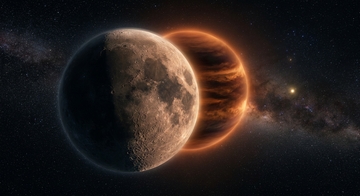
Astronomers may have found a new kind of object outside our Solar System: a possible moon that does not orbit a planet. Instead, it travels around a brown dwarf called CD-35 2722 B. A brown dwarf is heavier than a planet but not heavy enough to become a normal star. This brown dwarf has about 37 times the mass of Jupiter and orbits a small star about 73 light-years from Earth. (messenger.eso.org)
The moon-like object is also unusual because it is very large. Its minimum mass is about 90% of Jupiter’s mass, and it takes around 170 days to complete one orbit. In other words, it is large enough to be called a planet, but it does not orbit a star. It is the third level of the system: the object circles the brown dwarf, and the brown dwarf circles the star. (natureasia.com)
Scientists found the object with the Very Large Telescope in Chile. They studied the brown dwarf from October 2023 to February 2026. The team used the radial velocity method, which measures small changes in an object’s movement. The possible satellite pulls on the brown dwarf with its gravity, making the brown dwarf move slightly backward and forward. (messenger.eso.org)
The discovery raises an interesting question: What should we call this object? An exomoon usually means a moon outside our Solar System, but moons normally orbit planets. The researchers therefore prefer the more general word “exosatellite.” More observations are still needed, so it remains a candidate rather than a fully confirmed exomoon.
Even so, the discovery is important. Scientists have found more than 6,000 exoplanets, but no exomoon has been confirmed without serious doubt. This strange system may help astronomers understand how moons, planets, and brown dwarfs form. It also shows that nature does not always fit neatly into the names that humans have created. (messenger.eso.org)