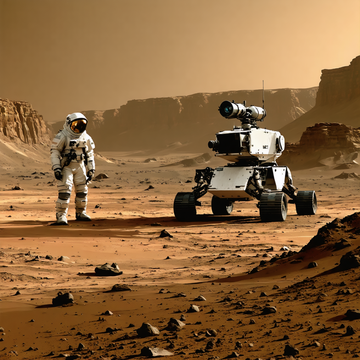
When many people hear “organic molecules,” they immediately think “life.” On Mars, however, the word is more complicated. In chemistry, an organic molecule is simply a carbon-based compound. NASA’s Curiosity rover made the first definitive detection of Martian organic molecules in a mudstone sample from Gale Crater, announced on December 16, 2014. Even then, scientists warned that such molecules might come from non-living chemistry, including reactions in watery environments or material delivered by meteorites and comets. (nasa.gov)
The mystery became even more exciting in March 2025. Curiosity detected decane, undecane, and dodecane in the ancient Cumberland mudstone—the largest organic molecules yet found on Mars. Researchers think these compounds may be fragments of fatty acids, which on Earth help form cell membranes. That sounds dramatic, but it is not a smoking gun: fatty acids can also be produced without life. Still, the setting matters. Cumberland records Gale Crater’s 3.7-billion-year past, and NASA says liquid water probably existed there for millions of years, giving prebiotic chemistry plenty of time to develop. (science.nasa.gov)
Then came another major step. On April 21, 2026, NASA reported that a different Curiosity sample, “Mary Anning 3,” contained 21 carbon-bearing molecules, seven never before identified on Mars. A Nature Communications paper described more than 20 organic molecules in roughly 3.5-billion-year-old clay-rich sandstone, including benzothiophene and a nitrogen heterocycle, a structure related to the chemistry behind RNA and DNA. Just as important, these molecules appear to have survived billions of years of radiation and geological change. (jpl.nasa.gov)
So, have we found evidence of life? Not yet. A February 4, 2026 study in Astrobiology argued that the original amount of long-chain alkanes in the Cumberland rock is difficult to explain by meteorites or ancient atmospheric haze alone. The authors said a biological origin is a reasonable hypothesis, but they stopped well short of claiming proof. For now, Mars is still teasing us: the planet seems to have had the ingredients for life, but whether these molecules are a true biological clue or only clever chemistry remains an open question. (journals.sagepub.com)