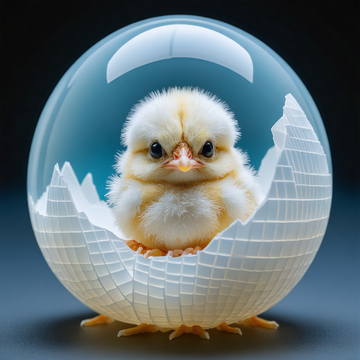
A chick hatching from a 3D-printed “egg” sounds like a movie scene, but it became real in May 2026. Colossal Biosciences, a biotech company in Dallas, announced that it had hatched 26 baby chickens using a 3D-printed structure that acts like an eggshell. The company hopes this technology could one day help research on endangered birds and support its long-term project to create birds that resemble extinct species, including New Zealand’s South Island giant moa. According to the company and outside reporting, a moa egg may have been about 80 times the volume of a chicken egg, which makes the problem especially difficult. (apnews.com)
The system is not a complete replacement for a natural egg from the very beginning. First, a real hen still lays a fertilized egg. Then scientists move the contents into an artificial container. Colossal says its design uses a thin silicone-based membrane inside a rigid support cup. This membrane is made to let oxygen pass through while keeping moisture inside, like a real eggshell. The company also says the device can be watched in real time, so researchers can see the embryo develop more clearly than in a normal egg. (apnews.com)
Still, many scientists are being careful, not celebratory. Experts quoted by AP said this is closer to an artificial eggshell than a full artificial egg, because other important parts of egg development were not recreated. They also noted that chicks have been grown in unusual artificial containers before, so the basic idea is not entirely new. What seems most impressive here is the membrane and the possibility of scaling the system to different sizes. As of early June 2026, no peer-reviewed paper or public dataset had been released, so other scientists had not yet fully checked the results for themselves. (apnews.com)
Even with those doubts, the news is exciting because it shows how biology and engineering can work together. If the method is confirmed, it could become a useful tool for studying how birds grow and for helping some threatened species. At the same time, experts remind us that bringing back an extinct bird is much harder than hatching a chick. Making a bird that looks like a moa is not the same as truly restoring the lost animal—or its lost world. (apnews.com)