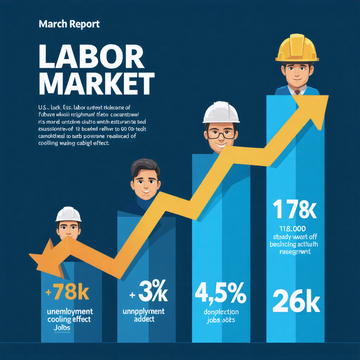
On April 3, 2026, the U.S. Bureau of Labor Statistics reported that employers added 178,000 jobs in March. This was a strong recovery after February, when payrolls fell by 133,000 after revisions. The unemployment rate was 4.3%, slightly lower than 4.4% in February. The March gain was also much stronger than many economists had expected. (bls.gov)
The biggest job growth came from health care, which added 76,000 jobs. Construction added 26,000 jobs, and transportation and warehousing added 21,000. But not every area improved. Federal government employment fell by 18,000 in March, and it has dropped by 355,000 since October 2024. This shows that today’s U.S. job market is changing: some service industries are still hiring, while government jobs are shrinking. (bls.gov)
Another important sign comes from job openings data. In February 2026, job openings were little changed at 6.9 million, but hires fell to 4.8 million. The hires rate dropped to 3.1%, the lowest level since April 2020. Quits stayed at 3.0 million, which suggests workers are not leaving jobs as freely as before. In simple terms, companies still have openings, but many are hiring more carefully. (bls.gov)
Pay is still rising, but more slowly. Average hourly earnings increased by 0.2% in March and by 3.5% from a year earlier. According to AP, that was the smallest yearly wage gain since May 2021. At the same time, the labor force participation rate was 61.9%, almost unchanged. So, March brought real recovery, but the larger story is a cooler and more balanced job market. For English learners, a useful phrase here is “steady, not fast.” That may be the best way to describe the U.S. labor market in spring 2026. (bls.gov)