Saturn has just given us a view that may not return for many years. On March 25, 2026, NASA released a new pair of Saturn images: one taken by Hubble in visible light on August 22, 2024, and another taken by Webb in infrared on November 29, 2024. Seen together, they create what NASA calls its most comprehensive view of Saturn so far, because the two telescopes reveal different layers and features of the planet’s atmosphere. (science.nasa.gov)
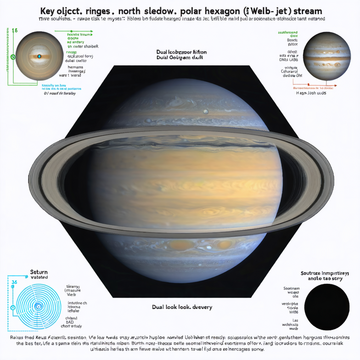
The contrast is beautiful and scientifically useful. In Hubble’s image, Saturn looks soft and familiar, with pale yellow cloud bands, bright rings, and even the shadow of the moon Mimas on the planet. In Webb’s infrared view, the icy rings shine much more strongly, and the atmosphere looks more layered and complex. Webb also shows a long-lasting jet stream called the “ribbon wave,” a lingering mark from the huge “Great Springtime Storm” of 2010 to 2012, and several storms in Saturn’s southern hemisphere. (science.nasa.gov)
Most exciting of all, both images still show faint edges of Saturn’s mysterious north-polar hexagon. This six-sided jet stream was first discovered by Voyager in 1981 and has remained one of the strangest weather patterns in the solar system. NASA says these may be the last high-resolution views of the hexagon until the 2040s, because Saturn’s north pole is entering winter and will spend about 15 years in darkness. In other words, we are looking at the end of a rare viewing season. (science.nasa.gov)
That timing is connected to Saturn’s slow movement around the Sun. One Saturn year lasts more than 29 Earth years, and each season lasts about seven years. NASA notes that the 2024 observations were made as Saturn moved toward its 2025 equinox. Hubble’s long-running OPAL program, together with Webb’s infrared power and the earlier Cassini mission, is helping scientists follow these slow seasonal changes in a way no single mission could do alone. (science.nasa.gov)