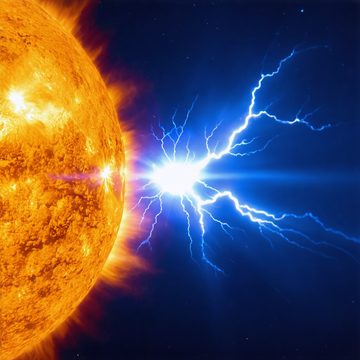
Can scientists predict solar flares? The short answer is: partly, but not perfectly yet. Today, NOAA already gives 1-day to 3-day probability forecasts for medium and strong flares, but exact timing is still very difficult. This matters because strong solar flares can disturb Earth’s upper atmosphere, cause radio blackouts, and create risks for satellites and astronauts. NASA and NOAA also say the Sun is in the solar maximum phase of Solar Cycle 25, so this research is especially important now. (swpc.noaa.gov)
One important new result came from a NASA-supported study highlighted in January 2025. Researchers studied coronal loops, huge arcs of hot gas above active regions on the Sun. Using data from NASA’s Solar Dynamics Observatory, they found that these loops “flicker” more strongly in extreme-ultraviolet light for hours before many large flares. In their sample of about 50 strong flares, this method suggested warning times of about 2 to 6 hours, with about 60% to 80% accuracy. That is exciting because many older methods mostly predict general chance, not a more exact time. (science.nasa.gov)
Another 2025 study, published in The Astrophysical Journal, looked at small extreme-ultraviolet brightenings before flares. The researchers checked 360 flares and found these signs within 6 hours before 92% of C-class-or-stronger flares. During quiet periods with no flares, similar signs appeared only 4% of the time. The team also found timing patterns: for M-class flares, the signal peaked about 100 minutes before the eruption, while X-class flares showed peaks several hours before. (repository.library.noaa.gov)
So, can solar flares be predicted? Not like tomorrow’s rain yet. But scientists are finding useful short-term warning signs in the Sun’s light and magnetic activity. A 2025 preprint also reported that changes in magnetic current, twist, shear, and free energy grew stronger about 2 to 4 hours before 18 flares. If these clues keep working in larger studies, future forecasts may become faster, more precise, and more helpful for protecting technology on Earth and in space. (arxiv.org)