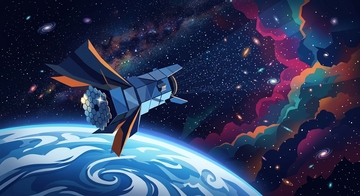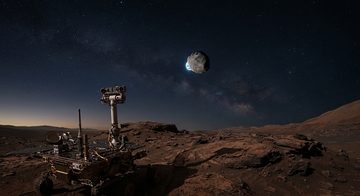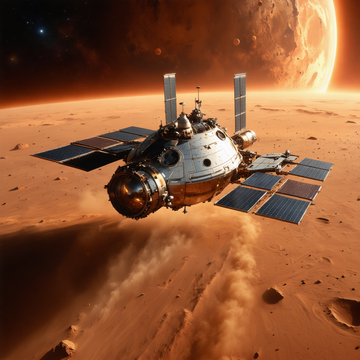
Mars is not only a red planet in the night sky. It is also a dusty, cold desert world with a very thin atmosphere, and its weather can change with winds, dust, clouds, and seasons. For scientists, this makes Mars exciting. For spacecraft and future astronauts, it makes Mars difficult and sometimes dangerous. (science.nasa.gov)
To learn more, NASA announced a new public-private mission on June 17, 2026. NASA will work with the private company Relativity Space. NASA will provide the science instruments, and Relativity Space will provide the spacecraft, the rocket, and the operations for the trip to Mars. The mission is called Aeolus, and NASA says it is scheduled to launch in 2028. (nasa.gov)
Aeolus is special because it will study Mars’s weather every day on a global scale. NASA says the mission’s four instruments will give the first integrated, daily, planet-wide view of Martian winds, temperatures, dust, and clouds. One instrument will also take daily wide images of atmospheric activity. In simple words, Aeolus will help scientists make a kind of daily weather report for Mars. (nasa.gov)
This is important for the future. NASA says better weather models can reduce risk for both robotic missions and human landings, especially during entry, descent, and landing through the Martian atmosphere. Researchers at NASA Ames Research Center will build and integrate the payload, while Relativity Space will handle spacecraft development and mission operations. NASA also plans to support the science instruments for at least one Martian year and turn the raw measurements into useful data for researchers. (nasa.gov)
Aeolus also shows a bigger change in NASA’s Mars strategy. NASA says it wants to send lower-cost, high-science missions to Mars more often, using stronger partnerships with industry. If Aeolus succeeds, the mission will not only teach us about Mars’s weather. It may also help open the way for the first humans to land there more safely one day. (science.nasa.gov)