Have you ever kept an old phone because it still works so well? NASA feels a little like that now. Its Swift space telescope launched on November 20, 2004. It was built for a two-year mission. But more than 21 years later, Swift is still important. For years, it has helped scientists study gamma-ray bursts, some of the biggest explosions in space, along with many other fast-changing objects. (science.nasa.gov)
But now there is a problem. Swift is not failing inside. It is slowly falling. Even high above Earth, a thin outer layer of the atmosphere creates drag. Recent strong solar activity made that drag worse, so Swift started losing height faster than expected. To buy more time, NASA stopped most of Swift’s science work on February 11, 2026, and kept the spacecraft in a position that cuts drag. The team wants Swift to stay above about 300 kilometers, because that gives the rescue a better chance to work. (science.nasa.gov)
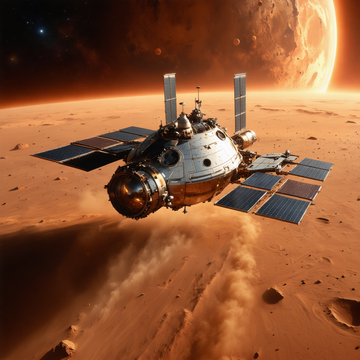
So here comes the rescue plan. Instead of letting Swift fall back to Earth, NASA hired Katalyst Space to build a small robot spacecraft called LINK. LINK has three robotic arms. It will meet Swift, check it carefully, grab it, and then slowly push it back toward nearly its original orbit, around 600 kilometers. As of June 19, 2026, the plane carrying the Pegasus XL rocket and LINK had already left NASA’s Wallops site for Kwajalein Atoll, with launch planned for later in June. If this works, it will be the first commercial robotic mission to capture and raise a NASA spacecraft that was never designed for servicing. Sometimes the future does not begin with something brand new. Sometimes it begins by saving something old. (science.nasa.gov)