Why would a whole class laugh at a math answer?
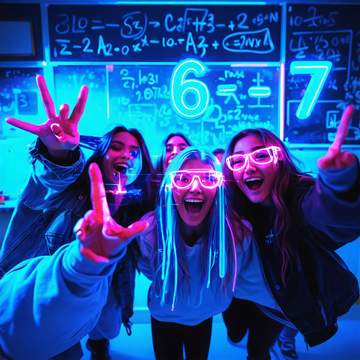
A teacher says, “What’s 120 minus 53?” One boy whispers, “six seven.” Two friends repeat it. Then half the room is smiling. If you hear this and feel lost, you’re not alone. “6-7,” usually said as “six seven,” is a Gen Alpha slang meme. It grew from Skrilla’s song “Doot Doot (6 7)” and spread through TikTok, Instagram, and basketball clips linked to LaMelo Ball, who is 6 foot 7. Dictionaries say the phrase is mostly nonsense, though some kids use it with a little up-and-down hand motion to suggest something like “so-so.” (merriam-webster.com)
Now here’s the interesting part. The weak meaning is exactly why the slang is strong. Psychologists say slang helps young people test identity, show independence, and feel that they belong to a group. With “6-7,” the joke is not really the definition. The joke is knowing when to say it, how to say it, and who will understand it. That shared timing creates an in-group, especially when adults look confused. (apa.org)
Researchers who study Generation Alpha say this kind of language is shaped by platforms. Short sounds, repetition, gesture, and remix matter more than clear dictionary meaning. In that world, “6-7” works less like a normal word and more like a badge. You wear it for a moment, with your voice and your body, to say, “I’m part of this world too.” (frontiersin.org)
So if two random numbers suddenly make kids laugh, maybe the real message is simple. Even nonsense can become a home signal, a tiny way of saying, “You belong here.”