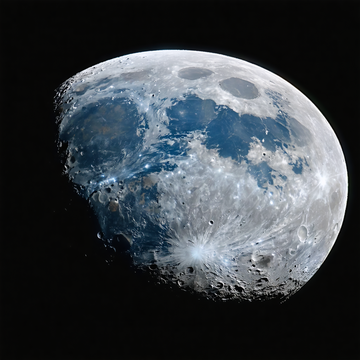
The far side of the Moon has always felt mysterious because people on Earth cannot see it directly. In April 2026, Artemis II gave us a new look. NASA’s Orion spacecraft launched on April 1, 2026, with four astronauts: Reid Wiseman, Victor Glover, Christina Koch, and Jeremy Hansen of the Canadian Space Agency. On April 6, during a seven-hour flyby, they traveled behind the Moon and photographed the far side. NASA says this was humanity’s first return to the Moon’s neighborhood since Apollo 17 in 1972. (nasa.gov)
One of the most beautiful images was “Earthset.” From behind the Moon, the crew watched Earth sink behind the lunar horizon, like a mirror image of the famous Apollo 8 “Earthrise” photo. They also saw a total solar eclipse in space. The far side is sometimes called the Moon’s “dark side,” but that is not correct. It is simply the side that always faces away from Earth. During the Artemis II flyby, only about 20% of the far side was lit by sunlight, while 80% was in darkness, which made the view even more dramatic. (science.nasa.gov)
These pictures were not only beautiful; they were also useful for science. As Orion passed over the far side, the astronauts photographed and described impact craters, ancient lava flows, and long cracks and ridges on the surface. NASA says these details can help scientists understand the Moon’s history and prepare for future missions, especially near the Moon’s south pole. Artemis II ended on April 10, 2026, when Orion splashed down in the Pacific Ocean after a nearly 10-day mission. The trip also set a new human distance record: 252,756 miles from Earth. Artemis II showed that the far side of the Moon is not just a hidden place. It is a place full of stories, science, and wonder. (nasa.gov)