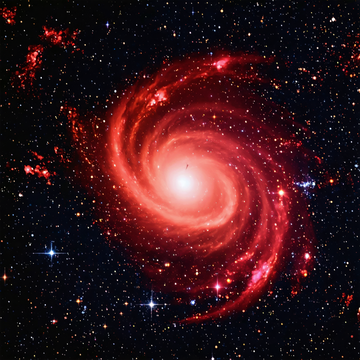
For a long time, astronomers assumed that galaxies came first and black holes followed: stars formed inside young galaxies, some collapsed, and their black holes gradually grew larger through mergers and accretion. But the James Webb Space Telescope, or JWST, has made that tidy story look far less certain. In late 2022, Webb began revealing a strange new population of tiny, compact, reddish objects in the early universe. Researchers nicknamed them “little red dots,” and many seem to have existed within the universe’s first 1.5 billion years. (science.nasa.gov)
These objects matter because they may record a hidden phase of early black hole growth. One large JWST study found that little red dots become common roughly 600 million years after the Big Bang, then decline sharply by around 1.5 billion years. Spectra from the RUBIES survey showed that about 70% of the sampled objects contained gas moving at around 1,000 kilometers per second, a strong sign of material orbiting a growing supermassive black hole. Another study reported a confirmed AGN fraction of 71% in a bright sample, while earlier spectroscopy had already shown that many red compact sources at redshift above 5 were indeed dust-reddened active galactic nuclei rather than ordinary galaxies. (science.nasa.gov)
The debate is not completely over, but the strongest recent evidence points toward black holes. In a Nature paper published on January 14, 2026, researchers argued that many little red dots are young supermassive black holes wrapped in dense ionized “cocoons.” In that model, the broad spectral lines are produced largely by electron scattering, and the inferred black hole masses are around 10^5 to 10^7 solar masses, lower than some earlier estimates but still powerful enough to dominate the light we see. (nature.com)
Then came the most dramatic result. In a Nature paper published on May 27, 2026, astronomers directly measured the mass of the black hole inside Abell2744-QSO1, a little red dot seen at redshift 7.04, only about 700 million years after the Big Bang. They found a black hole of about 50 million solar masses, with so little stellar mass around it that the object appears almost “naked.” Its black-hole-to-stellar-mass ratio is greater than 2, and its environment seems chemically near-pristine. That does not prove every little red dot is a black hole born before its galaxy, but it strongly suggests that, in at least some cases, the black hole may have arrived first. (nature.com)