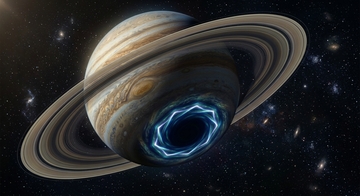
Saturn is famous for its beautiful rings, but the planet has another surprising feature. Scientists have discovered a huge ten-sided pattern around its south pole. A shape with ten sides is called a “decagon.” The discovery was announced on September 2, 2026, after researchers studied images from the Hubble Space Telescope and telescopes on Earth. (science.nasa.gov)
The decagon is not a solid object. It is a wave inside one of Saturn’s powerful jet streams. The winds there can reach about 400 kilometers per hour. However, the whole ten-sided pattern moves much more slowly compared with Saturn’s rotation—at around 10 kilometers per hour. Hubble observations also show that the wave reaches through several levels of the atmosphere, so it is more than a simple cloud pattern. (science.nasa.gov)
The first signs appeared in Hubble data from 2023. In 2024, amateur astronomers noticed an unusual wavy band in their own pictures of Saturn. Later images made the ten-sided shape clearer. This shows that people with smaller telescopes can still play a valuable role in space science. (science.nasa.gov)
Saturn already has a six-sided wave, or hexagon, around its north pole. That pattern has remained for more than 40 years. The new southern decagon seems less stable, and some of its corners are clearer than others. Scientists do not yet know exactly why it formed or how long it will last. They plan to continue watching it with Hubble, the James Webb Space Telescope, and observatories on Earth. If the decagon changes or disappears, regular observations may help researchers understand the strange weather of giant planets—and perhaps atmospheric waves on Earth as well. (science.nasa.gov)