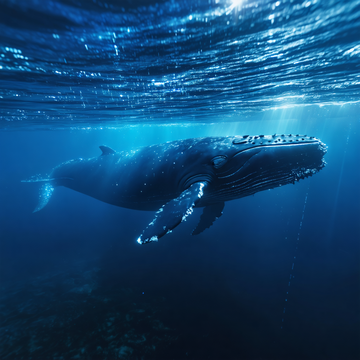
Whales are huge, but the ocean is much bigger. So whales can be very hard to find and protect. This is especially true for the North Atlantic right whale, one of the world’s most endangered large whale species. NOAA says there are about 380 of these whales left, and only about 70 females can have calves. Two major dangers are ship strikes and getting caught in fishing gear. (fisheries.noaa.gov)
Today, AI helps protect whales by listening to the sea. Underwater microphones on buoys and recorders can catch whale sounds. Then AI checks the sound data much faster than people can. One system, Whale Safe, uses whale sounds, whale sightings, and ocean data to show how likely whales are to be in an area. It gives near real-time information for places such as the Santa Barbara Channel and the San Francisco region, so ships can slow down when risk is high. NOAA also says real-time passive acoustic monitoring is already a highly ready tool for detecting whales in a region. (bosl.ucsb.edu)
AI can also protect whales by seeing them. NOAA’s GAIA project uses very high-resolution satellite images and machine learning to detect North Atlantic right whales from space. In one satellite image over Cape Cod Bay, four right whales were visible at the same time. AI is also used to match whale photos to known individuals in the North Atlantic Right Whale Catalog. This helps scientists follow each whale over many years and learn about its health, movement, and survival. (fisheries.noaa.gov)
Another big job for AI is studying huge amounts of sound. In September 2024, NOAA said it worked with Google AI to search more than 500 terabytes of whale recordings. The system helped scientists identify the strange “Biotwang” sound as a call from Bryde’s whales. NOAA said AI made this work possible in hours instead of years. That means scientists can learn faster about where whales live and when they are present. (fisheries.noaa.gov)
AI is not magic. People still need to check the data and act on it. But AI gives scientists fast ears, sharp eyes, and better warnings. When ships get alerts and slow down, whales have a better chance to live safely in busy seas. (fisheries.noaa.gov)