Artemis II has already changed the meaning of the word “return” in space exploration. On April 1, 2026, NASA launched the Orion spacecraft atop its Space Launch System rocket from Kennedy Space Center, carrying Reid Wiseman, Victor Glover, Christina Koch, and Canadian astronaut Jeremy Hansen. This is the first crewed mission of the Artemis program, the first time astronauts have flown on SLS and Orion, and NASA’s first crewed lunar flyby mission in more than half a century. Officially, it is a 10-day test flight; emotionally, it feels like the reopening of deep space to human travelers. (nasa.gov)
What makes Artemis II especially important is that it is not just a nostalgic replay of Apollo. After launch, Orion completed a series of carefully planned burns, including the translunar injection burn on April 2 that sent humans out of Earth orbit toward the Moon for the first time since 1972. Along the way, the crew tested manual piloting in deep space, reviewed lunar imaging targets, evaluated spacesuits and exercise systems, and practiced procedures that future astronauts will need when missions become longer and more demanding. NASA describes Artemis II as a key step toward later lunar surface missions and, ultimately, human missions to Mars. (nasa.gov)
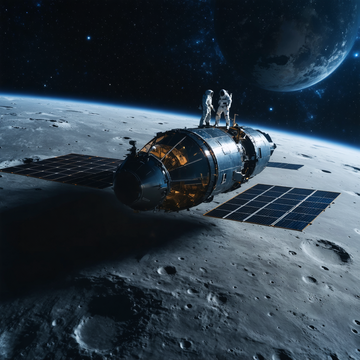
The mission’s most dramatic chapter came on April 6, when Orion completed a historic lunar flyby. During that seven-hour period, the spacecraft passed about 4,067 miles above the Moon, photographed the far side, and gave the crew remarkable views of Earthset, Earthrise, and a nearly hour-long solar eclipse. On the same day, the astronauts surpassed Apollo 13’s long-standing distance record, eventually reaching 252,756 miles from Earth at Orion’s farthest point. By NASA’s April 10 update, the spacecraft had completed its final return burn and was preparing for splashdown off the coast of San Diego. If Apollo proved that humans could reach the Moon, Artemis II suggests something just as powerful: that journeys to the Moon may once again become part of humanity’s future, not merely its history. (nasa.gov)