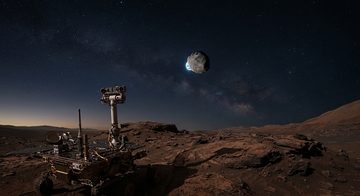
Comet 3I/ATLAS is a very special visitor. It was first reported on July 1, 2025, by the NASA-funded ATLAS survey telescope in Chile, and astronomers quickly realized that it had come from outside our solar system. That makes it only the third known interstellar object ever observed. It never threatened Earth, coming no closer than about 270 million kilometers, and it reached its closest point to the Sun in late October 2025 before heading back out into deep space. (science.nasa.gov)
The newest surprise came from the James Webb Space Telescope. In observations made on December 15–16 and December 27, 2025, Webb used its mid-infrared instrument to study the comet’s gases after its close pass by the Sun. For the first time in any interstellar visitor, scientists directly detected methane. This was a big moment, because methane is a very volatile gas: it changes from ice to gas easily, so researchers did not expect it to appear in such a puzzling way. (science.nasa.gov)
So what is the mystery? The methane did not seem to come from the comet’s outer surface right away. Instead, NASA says its delayed appearance suggests that the methane was buried under the top layer of the comet and stayed protected until sunlight warmed deeper ice below the surface. Webb also found that 3I/ATLAS has a surprisingly high methane-to-water ratio and is unusually rich in carbon dioxide compared with most comets from our own solar system. As the comet moved farther from the Sun, its gas output fell sharply, and water dropped the fastest. (science.nasa.gov)
These clues make 3I/ATLAS exciting for scientists and learners alike. Webb’s data show that water spreads far out into the comet’s coma, while methane and carbon dioxide stay more concentrated near the nucleus. A later 2026 study also reported that the comet’s methane was unusually rich in deuterium, a heavy form of hydrogen. Taken together, these results suggest that 3I/ATLAS probably formed in a much colder and chemically different environment around another star. In other words, the methane is not just a gas—it may be a message from another planetary system. (science.nasa.gov)