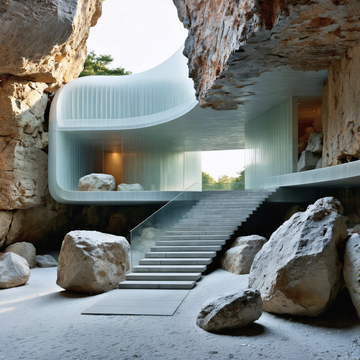
In 2026, the Pritzker Architecture Prize went to Smiljan Radić Clarke, an architect from Santiago, Chile. The prize jury said his work stands at the meeting point of uncertainty, material experiment, and cultural memory, and praised him for choosing “fragility” instead of false certainty. That idea is important: Radić’s buildings often look light, temporary, or even slightly unfinished, yet they still give people a strong feeling of shelter. In his work, weakness is not a problem to hide. It becomes part of architecture itself. (pritzkerprize.com)
This is what makes Radić so interesting. Many famous buildings try to impress us with size, power, or bright visual effects. Radić often does the opposite. His Serpentine Gallery Pavilion in London, built in 2014, used a translucent fiberglass shell resting on large local stones, creating a space that felt both open and protected. At Teatro Regional del Biobío in Concepción, completed in 2018, a soft semi-translucent outer skin controls light and supports the building’s acoustic needs. In House for the Poem of the Right Angle in Vilches, built in 2013, carefully placed openings invite quiet thought, light, and a strong sense of time passing. (pritzkerprize.com)
Radić’s own life helps explain this gentle but powerful architecture. Born in Santiago to a family with Croatian and British roots, he has spoken about the need to create your own roots and your own sense of belonging. He opened his practice in 1995 and has kept it intentionally small. In 2017, he also founded Fundación de Arquitectura Frágil in Santiago to support experimental architecture. For English learners, Radić’s story offers a useful lesson: “fragile” does not always mean weak. In his architecture, fragility can mean sensitivity, care, and the courage to make spaces that feel deeply human. (pritzkerprize.com)