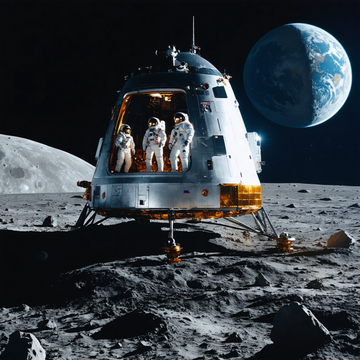
More than fifty years after the Apollo era, humans have traveled around the Moon again. NASA’s Artemis II mission launched from Kennedy Space Center in Florida on April 1, 2026, with four astronauts aboard Orion: Reid Wiseman, Victor Glover, Christina Koch, and Canadian astronaut Jeremy Hansen. After almost ten days in space, the crew returned safely on April 10, splashing down in the Pacific Ocean off the coast of California. Artemis II was the first crewed mission in the Artemis program and humanity’s first return to the Moon’s neighborhood since Apollo 17 in 1972. (nasa.gov)
The mission did not land on the Moon, but it still made history. On April 6, Orion passed about 4,067 miles above the lunar surface during its flyby. That same day, the crew broke the old Apollo 13 record for the farthest human spaceflight, first passing 248,655 miles from Earth and later reaching about 252,756 miles from Earth at the mission’s most distant point. Artemis II was also an important test. The astronauts checked life-support systems, practiced manual control of the spacecraft, reviewed emergency procedures, and gathered health data through experiments such as AVATAR, which studies how radiation and microgravity affect human tissue. They also took more than 7,000 images of the Moon, Earth, and a solar eclipse seen from Orion. (nasa.gov)
Why does Artemis II matter so much? Because it showed that NASA’s Orion spacecraft and SLS rocket can carry people safely into deep space and bring them home. NASA now says Artemis III is planned for 2027 as a crewed mission in low Earth orbit to test docking with commercial lunar landers, and Artemis IV is aimed at returning astronauts to the Moon in 2028. So Artemis II was not only a celebration of the past. It was the start of a new age of exploration, built step by step for longer, more serious missions beyond Earth. (nasa.gov)