In planetary defence, the most important missions are often conceived before there is any emergency. That is why the new ESA-JAXA alliance around Ramses matters. On 7 May 2026, the two agencies signed both a broader memorandum on planetary defence and a dedicated cooperation agreement for Ramses, the Rapid Apophis Mission for Space Safety. ESA says the mission is on track for a 2028 launch, while JAXA has confirmed that Japan will provide lightweight solar array wings, a thermal infrared imager, and the H3 launch vehicle, making Ramses a truly joint mission rather than a merely diplomatic gesture. (esa.int)
The target is 99942 Apophis, a near-Earth asteroid about 375 meters across. On 13 April 2029, it will pass safely within roughly 32,000 kilometers of Earth’s surface, closer than geostationary orbit. NASA emphasizes that Apophis poses no immediate danger, but the encounter is exceptionally rare and scientifically invaluable. Earth’s gravity is expected to pull, twist, and stress the asteroid, altering its orbit and spin and perhaps disturbing its surface. For researchers, this is a natural experiment that cannot be staged in a laboratory. (esa.int)
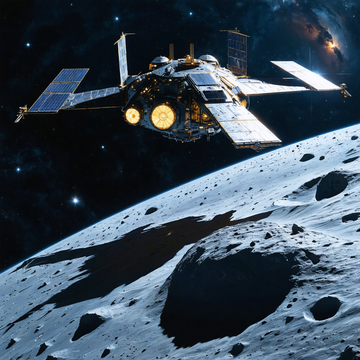
Ramses is meant to witness that transformation from close range. ESA planning documents state that the spacecraft will study Apophis before, during, and after the flyby, measuring its orbit, rotation, surface changes, interior structure, and even any tiny dust particles released by tidal forces. This is why the mission matters beyond astronomy. If humanity ever needs to deflect a hazardous asteroid, scientists must first understand how such bodies respond to outside forces. Ramses turns Apophis from a spectacle into a full-scale rehearsal for future planetary defence. (nebula.esa.int)
The timing is symbolically perfect as well. The United Nations has designated 2029 the International Year of Asteroid Awareness and Planetary Defence, and Ramses gives that declaration practical meaning. NASA’s OSIRIS-APEX is expected to rendezvous with Apophis in June 2029, after the close approach, so the ESA-JAXA mission would fill the crucial pre-encounter gap. In that sense, Ramses may change more than our knowledge of one asteroid: it may redefine planetary defence as a discipline of international preparation rather than national reaction. (science.nasa.gov)