The planet is not merely warming; it is being stripped of one of the veils that had partially concealed the full force of greenhouse-gas heating. The World Meteorological Organization says 2024 was likely the first calendar year to exceed 1.5°C above the 1850–1900 average, reaching 1.55 ± 0.13°C, with record greenhouse-gas concentrations, El Niño, and “other factors” all helping to drive the heat. One of those factors is the decline of cooling aerosols: tiny particles, especially sulfates from fossil-fuel combustion, that reflect sunlight and brighten clouds. NASA notes that aerosol pollution has made Earth about 0.4°C cooler than it otherwise would have been, even though the same pollution is deeply harmful to human health. (public.wmo.int)
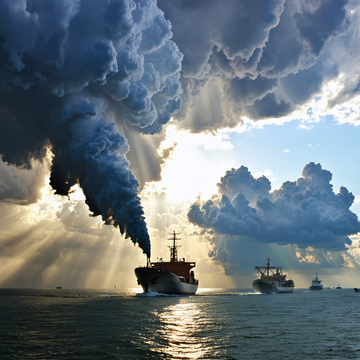
This is the paradox of “hidden warming.” Dirty air never solved climate change; it merely masked part of it. As countries clean up sulfur pollution, that temporary cooling weakens, and the underlying greenhouse signal appears more starkly. A vivid example comes from shipping. Under the IMO 2020 rule, the sulfur limit in marine fuel outside emission-control areas fell from 3.5% to 0.5%. NOAA reports that the resulting loss of some reflective ship-track clouds produced a modest but measurable warming effect, and recent studies have linked reduced cloud reflectivity over major ocean regions to unusually high temperatures in 2023. (imo.org)
The newest research suggests that shipping is only part of the story. A 2025 study in Communications Earth & Environment argues that the cleanup of East Asian aerosol emissions—especially sulfur dioxide reductions since around 2010—has likely contributed to the recent acceleration of global warming. Using eight Earth system models, the authors estimate a global warming effect of 0.07 ± 0.05°C from a 20 Tg/year reduction in East Asian SO2 emissions, and conclude that this cleanup may have added up to 0.05°C per decade to post-2010 warming. Still, the authors are careful: they stress that methane, low-cloud changes, internal variability, and post-2020 shipping rules also matter, and that the exact share attributable to aerosol decline remains uncertain. (nature.com)
So the real lesson is not that clean air is a mistake. It is that climate policy cannot rely on the accidental cooling effect of pollution. Sulfur cuts bring major health and environmental benefits, but once the aerosol mask thins, the world is left face to face with the warming created by CO2 and methane. In that sense, cleaner skies are telling the truth more clearly than ever. (imo.org)